Jerusalem
Description
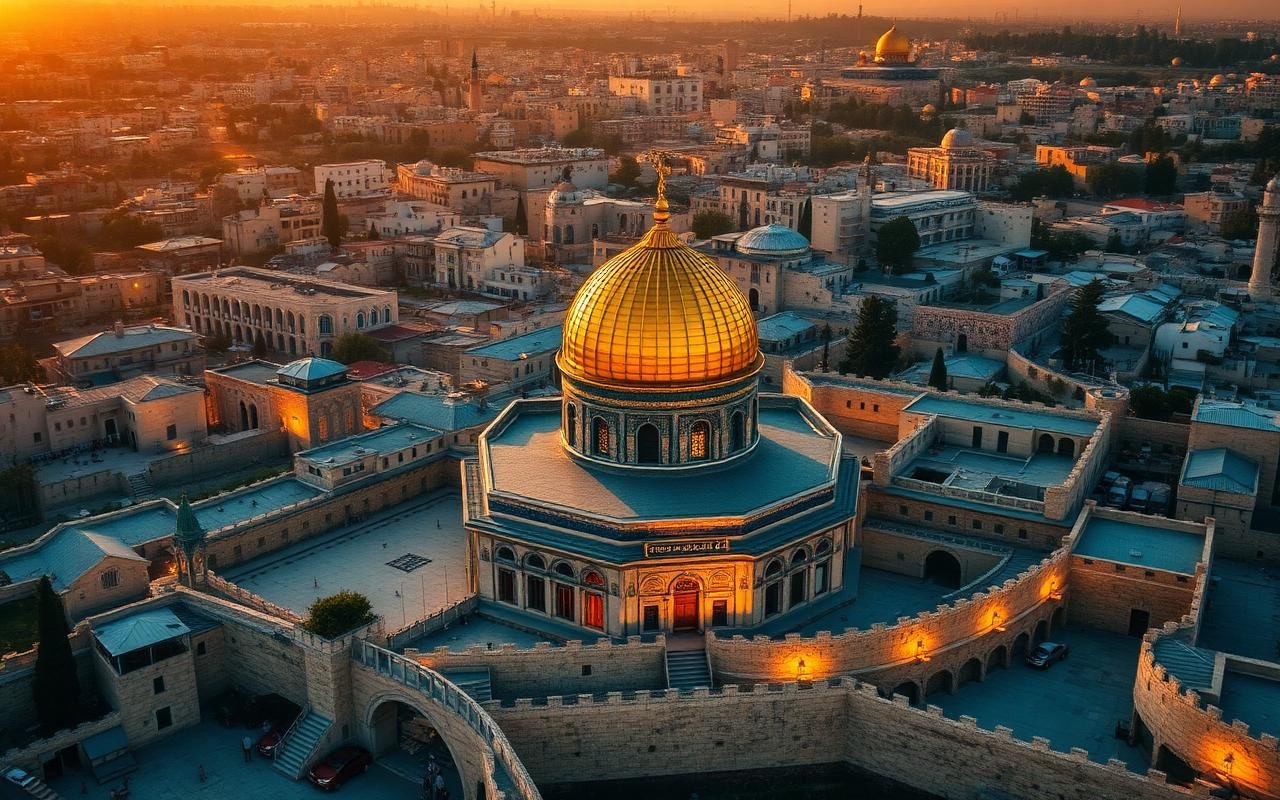
Jerusalem is one of the oldest cities in the world and among the most important historically and religiously, lying at the heart of Palestine. It is a unique cultural, civilisational and religious centre, home to many historic sites held sacred by Muslims, Christians and Jews. The city is distinguished by its ancient urban fabric, historic walls and old alleyways that reflect thousands of years of human civilisation.
Location
Jerusalem lies in the central part of historic Palestine, on a range of mountain plateaus between the Mediterranean Sea and the Dead Sea. It is about 60 kilometres east of the Mediterranean and 35 kilometres west of the Dead Sea, at around 750 metres above sea level. Its strategic location has given it great importance throughout history as a meeting point of trade routes and civilisations.
History of the city
Jerusalem is one of the oldest inhabited cities in the world, with a history stretching back more than five thousand years. It has seen a succession of civilisations, including the Canaanite, Jebusite, Assyrian, Babylonian, Persian, Greek, Roman, Islamic and Ottoman. It has held a prominent religious and cultural standing through the ages for its holy sites and historic landmarks of global importance.
The original inhabitants of Jerusalem
The Jebusites, one of the ancient Arab Canaanite tribes, are considered the original inhabitants of Jerusalem. They founded the city in the third millennium BC and named it "Jebus" after their tribe. Many peoples and civilisations followed, yet the Palestinian Arab presence has remained a fundamental part of the city's population and cultural identity through the centuries to this day.
Features of Jerusalem
- Home to the blessed Al-Aqsa Mosque and the Dome of the Rock.
- Contains the Church of the Holy Sepulchre, one of the most important holy sites for Christians.
- A historic and cultural centre with many museums and archaeological sites.
- A unique architectural style that blends the civilisations that succeeded one another there.
- One of the most important religious and tourist destinations in the world.
- Holds great political and symbolic significance for the Palestinian people.
Origin of the name
The name Al-Quds comes from the word for "holiness", meaning "the Holy City", reflecting its great religious standing among followers of the heavenly religions. Throughout history it has been known by many names, such as Urshalim and Bayt al-Maqdis, but "Al-Quds" or "Al-Quds Al-Sharif" has become the most widely used name in the Arab and Islamic world.
What do the Zionists call it?
Israeli authorities and Hebrew sources call the city "Yerushalayim" (Jerusalem / ירושלים), its Hebrew name. After occupying the eastern part of Jerusalem in 1967, Israel refers to the city as "unified Jerusalem" and considers it its capital, while Palestinians and most of the international community affirm that East Jerusalem is occupied Palestinian territory and regard it as the future capital of the State of Palestine.
In brief
- Jerusalem is the historic capital of Palestine and one of the holiest cities in the world. It combines a deep cultural and religious heritage and is home to the most prominent holy sites, making it a symbol of Palestinian identity and history.